
Classpecting Concerns & Literary Systems Notes
This page compiles all of my additional notes & references for my panel, Classpecting Concerns & Literary Systems, created for Pesterfest 2026, though not presented due to untimely illness. The entirety of the slides contents that would have been presented & supplemental information is still collected here in stand alone form.
TABLE OF CONTENTS
- Term Glossary
- Works Cited or Referenced
- Limitations & Futures
- Further Reading & Supplemental
- -- Further Reading
- -- Mythoslain Classpecting Bonus
TERM GLOSSARY
Archetype - As developed by psychologist Carl Jung, archetypes are universal, primordial images in the human collective unconscious which manifest in similar patterns across the art, dreams, myths, etc. of different cultures. Humans are born with these latent patterns, many of which are related to significant life milestones such as coming of age or the cycle of life. Archetype may also refer to recurring motifs or symbols across art or stories (often mythological). Some of what is considered a "character archetype" or "stock character" relates to elements of Jungian archetypes, but others are constructed by cultural conventions, chains of literary influence, & stereotype. Other similar uses of archetype can be for that which is a pattern or source for other things, a standard or "Platonic ideal."
Archetypal Literary Criticism - A no longer widely practiced form of criticism that centers recurrences of archetypes & myths across literary works. Mostly this pertains to Greek & Roman classics, select folklores, & biblical sources.
Author Function - An idea from Michel Foucault's 1969 lecture, "What Is an Author?," that some texts carry a specific role or regard for its author that meaningfully impacts societal contexts & discourse. Invoking the names of some authors expresses specific ideas about the "totality" of their thought &/or draws from sociohistorical context. The name Karl Marx extends past his authored works & into a world of other descendent discourses. The name of a fiction author like Ann Radcliffe is tied to the genre patterns of Gothic Romances that bloomed with styles evocative of her novels.
Collective Unconscious - Per Carl Jung, expanding on the idea of a personal unconscious which is the part of one's mind where repressed or forgotten memories dwell, the collective is a unified layer for all humans where archetypal patterns exist.
Note re: unconscious vs. subconscious - In common parlance, or merely that outside of psychoanalytic discussion, unconscious refers to the physical state of inability to respond to one's environment (sometimes colloquially also to an altered, less severe state like sleep). Subconscious refers to thoughts that are relatively accessible, but not in full awareness or focus. Commonly, people will use the two terms interchangeably when referring to anything not fully aware or conscious, such as absorbed biases or feelings one was acting on unknowingly. Generally to anything that is "not conscious." I see no issue in mixing the terms when it effectively gets the meaning across, but the distinction matters the second you start talking in actual psychoanalytic terms.
Cultural Studies - A broad area of study that branches into other disciplines, often sociology, that (when applied to literary criticism) often examines texts as it relates to broader culture or those works of pop culture, rather than "literary" texts or the canonical. There are numerous different applications & methods, many of which intersect with similar work of Marxists, structuralists, & poststructuralists.
Death of the Author - A concept/phrase taken from the title of Roland Barthes's 1967 essay which addresses the limitations imposed by overvaluing biographical or speculative aspects of a text's author in interpretation that risks privileging an intended secret or ultimate meaning of a text. More than the pre-existing idea of the Intentional Fallacy, Barthes empowers the reader & the act of reading that necessitates the death of the Author-God figure.
Deconstruction - In Philosophy, a major facet of Postructuralism most linked to the work of Jacques Derrida. Put concisely, "a theory of reading which aims to undermine the logic of opposition within texts" (Payne 180). Derrida wrote critically of concepts framed as dichotomies which are "merely a difference which has been manipulated into a hierarchy" (Payne 180). Deconstruction in this spirit, when applied to reading texts, entails the disentanglement of oppositional signification as an exploration of structure, without striving to resolve the conflicts in play. He also highlights the inherent issues of language that creates division by nature of signs & opens up potential misinterpretation. This extends to the perception of reading texts & how texts have been generally constructed. Derrida notably criticized Saussure's concepts of the sign, noting that the idea that the components of the sign share a fundamentally arbitrary link is at odds with the purported elevation of spoken word as being naturally closer to true meaning. This critique is captured in his influential concept of 'Différance,' a term that when spoken in French (his native language) it's pronounced entirely the same as the word it mispells (Différence). Using this term in this way explicitly privileges writing to make its distinction. The term captures meaning in the sense of "differ" & "defer." Not only is meaning constructed through differences & the inherent absence in signs, meaning is also deferred temporally. Meaning is every-changing & unstable with words only aquiring "proper" contextual meaning when its future contexts are reached whilst carrying the traces of words that preceded it. Yet at the end of the sentence there are often more & other words well beyond it that bend context & meaning producing an endless chain of meaning without any unity. There are other dimensions to Deconstruction making it all the harder to define with its emphasis on breaking down anything that could be used to define it (e.g. language). Derrida's concept of Deconstruction takes a stance on language that is sometimes criticized as denying the inextricable weaving of social contexts & constructs in practical life. Marxist critics challenge how the Deconstruction assertions that texts relate only to themselves & other texts are negligent of vital social contexts. Derrida eventually addressed Marxist thought, but for lack of a better phrasing or time, it's this Whole Thing.
Discourse - Broad term for talk or conversation, usually with an element of instruction or to indicate formality. A prominent modern usage is "to describe any organized body or corpus of statements and utterances governed by rules and conventions of which the user is largely unconscious" (Macey).
Essentialism - "Minimally, the doctrine that particular things necessarily possess essences or fixed natures in virtue of which they are what they are: particular things of determinate kinds" (Payne 238-9). There is no evidence of an actual essence, though ideas of what constitutes the essence of human nature is often discussed & culturally constructed. An example of a pervasive notion of essentialism is gender essentialism that insists on innate biological, psychological, & other characteristics linked to gender. This & other forms of essentialist thinking have been foundational to discriminatory ideologies.
Hegemony - (adj. hegemonic) Per relevant usage conceptualized by Antonio Gramsci, hegemony refers to the ideology of a dominant, ruling class that permeates its society in a manner that frames their conditions or status quo as natural & consented to.
Ideology - Elusive term critical to Marxist theory, cultural studies, & other fields. Grossly simplified, the term refers to a "distorted or illustory form of thought" & can also be used to negatively describe collective beliefs & attitudes of a class or other group (Macey). Often ideology refers to those perspectives of the dominant, ruling class. Concepts of ideology have evolved extensively over time & applied differently, though many applications extend from concepts drawn from the work of Louis Althusser who elaborated on the imaginary relationship ideology has with reality, how ideology produces/reproduces itself in a culture, & interfaces with/compromises the concept of the individual.
Intentional Fallacy - Argument of New Critics that the intent of a text's author is impossible to acquire & not conducive to judging a text. The text, not author speculation, is to be the primary source of meaning.
Literary Theory / Criticism - Literary Criticism is not what is commonly associated with the idea of "criticism," a negatively connotated discussion of something that seeks to emphasize something's flaws for the sake of a consumer review or other purpose. Value judgments are rare or absent from literary criticism which seeks to interpret a text or dissect its underlying philosophies. There is no consensus on a strict profile of what makes a work literary criticism, but there are abstract traits of a textual analysis that, if described as literary criticism, signals some set of abstract expectations of the analysis or its author's background. Criticism, as well as the term Literary Theory, can refer to a specific method of reading or critical lens employed in an analysis. These lenses/source texts are often interdisciplinary, meaning that they originate from other fields like sociology, political science, linguistics, etc. For a more thorough overview of what defines theory & criticism, see my zine Rat Criticism - Issue #1 & its supplements.
Marxist Theory - In literary criticism terms, this is the application of Marxist ideas to texts. A Marxist lens can involve readings based on textual depictions or relations of class struggle & broader social/ideological contexts text(s) exist in relation to. A common facet of Marxist readings concerns ideology, drawing from the works of Louis Althusser, in terms of the unconscious sets of beliefs & assumptions. Ideologies are produced, enforced, & bolstered by social structures of the dominant ideologies (hegemony) in ways that raise questions of autonomy. There are a great number of other methods & lenses drawn from Marxist thought & takes on other methods or disciplines greatly influenced by Marxism, like Cultural Studies.
Mimesis - A term spanning as far back as Plato & Aristotle, varied conceptions of mimesis concern imitation &/or mimicry. As it pertains to literature, it often comes with questions of realism & similarity to nature in what art or texts depicts. This raises the question of how the idea of "nature" is ideologically created & how artificial simulations can become more "real" than the original or otherwise confuse the relation between sign & symbol (hyperreality).
Monomyth - (or The Hero's Journey) As written by Joseph Campbell in his 1949 book, The Hero with a Thousand Faces, the Jung-inspired monomyth is a set of 17 stages across three core parts that are supposedly shared by many myths, though not all stages manifest or appear in the same order. He frames the structure as having an innate quality of human rites of passage, much like many archetypal patterns of Jung. Creators have since consciously applied this structure to their work. Many criticisms have been made of the monomyth for its selective view of mythology & folklore, essentialism, impact on public perception of folklore & mythology, & ideological messaging.
Myth - Myth can refer to a genre or mode of folk story that has social &/or cultural significance. Myth is often associated with religious tales of a specific culture, but can encompass other significant narratives. They serve multiple functions despite often being reduced to "false stories" or "pre-science" explanations. Despite this view of their falsehood, the sacred & historical qualities of myth which evoke ideas of "human nature" or "nature" itself gives way to other modern usages of myth like that of Roland Barthes, who writes from a semiotic perspective on myth as a function of ideology for naturalization.
Narratology - More specific than the broad study of narrative, narratology focuses on the structure of narrative & establishing a grammar of story. Many influential narratology concepts descend from work done with mythology & folktales. Narratology can also refer to a well-known debate in game studies opposing narratology (more traditional or conventional concerns of story & methods for analyzing story) with ludology (focus on the experience & act of playing games governed by interactivity).
New Criticism - A movement of the mid-20th century that valued close reading (i.e. treating a text as a closed & aesthetic object in-itself) as a response to the long reigning dominance of historical & other contexts.
Paradigm - A set of practices, beliefs, methods, models, etc. that comprise the accepted, legitimate concept of a discipline. Originally confined strictly to natural science fields by the source of this definition, Thomas Kuhn, it has since been applied to the knowledge base & structure of other disciplines.
Poststructuralism - A loose grouping of responses to structuralism that expand or dismantle elements of structuralism, such as the effects of the efforts to establish semiotics in a scientific sense. Often, Poststructuralism is characterized by the idea that there is no comprehensive unity or full underlying system of symbols or meaning. Symbols are maintained as fluid, ever-changing constructs that cannot exist independent of its context. Deconstruction is part of Poststructuralism, but not its entirety.
Psychoanalysis - A set of psychological theories established by Sigmund Freud focused on the unconscious facet of mind that governs more overt mental processes & observable behavior. One of the most famous concepts of Freudian Psychoanalysis is the three agent model of the psyche consisting of the id, ego, & superego. The id embodies needs of the body & impulse, often ones that are sexually charged or violent, driven by the need to seek pleasure & avoid pain (pleasure principle). The ego acts in logical response to reality (reality principle) by mediation of the id that would be incompatible with real life conditions. The superego forms from internalized sociocultural rules, largely those of authority or moral figures, acting as a "conscience." Other Freudian concepts, such as the Oedipus complex (idea of a child development stage defined by a son's attraction to his mother & management of hostility towards his father), are also sometimes applied in literary criticism. Jungian notions of archetypes also originate from Psychoanalysis. Most frequently, recent Psychoanalytic literary criticism draws from the expanded work of psychoanalyst Jacques Lacan, who often extended these concepts to language. Most influential of his ideas for criticism are the mirror stage & his triad of three orders. The mirror stage is a developmental range from 6 to 18 months wherein infants become able to recognize themselves in a mirror & identify with their reflection. The order of the imaginary stems from this stage as the ego forms where everything simply is in full until the introduction of rules, embodied in the concept of a Father. The symbolic then emerges when presence & absence makes itself known & things are identified in these terms. The third order, the real, is the impossible state of unmediated reality.
Schema - Per usage in psychology, schemas are organizing patterns of thoughts &/or behavior for the categorization of knowledge. Schemata are akin to mental models & are often invoked in the context of engaging with new information in terms of whether it conforms to one's pre-existing understanding (schema) or fails to. These categories can include stereotypes, roles, scripts, heuristics, & more including one's schema of their own self.
Semiotics - Semiotics (sometimes called semiology, the term originally used by influential founder of one European tradition, Ferdinand de Saussure) is the study of signs & can be broadly defined as the study "concerned with everything that can be taken as a sign" (Eco 7). Semiotics transcends linguistics by encompassing other nonlinguistic sign forms & systems, once again anything that can be taken as something else. Umberto Eco extends his definition to the discipline "studying everything which can be used in order to lie" (Eco 7). There are numerous subfields concerning different types of sign systems of culture, animals, codes, music, etc.
Sign -See Semiotics for the broadest definition & how it relates to the field. Per Ferdinand de Saussure, a sign is a dyadic unit of meaning composed of a signifier (sound-image) & a signified (concept). Both of these are not literal physical things, but are rather the mental or otherwise psychological impression of each (form). Modern takes on Saussurean tradition do embrace a more material form of signifier (Chandler 19). These components have an arbitrary (meaning no innate or logical) relationship & together comprise a sign. Alongside the sign, neither component can exist independently, but multiple signifiers can "point" to the same signified & vice-versa. Signs descended from the Saussure origins are not the only form as an American semiotic basis established from the works of Charles Sanders Peirce founded on a triadic sign produced its own lineage of semiotic practices.
Structuralism - A highly influential movement that casts focus on the underlying structure of a work operating at the levels of language, thought, & symbolism. Structuralism could be described as efforts to establish a unifying methodology founded in semiotics, particularly those descended from Saussure. It employs a systematic approach to the production of meaning, understanding how relations contribute to meaning, & sometimes paying more attention to the role of the reader.
Primary Terms Sources
Macey, David. The Penguin Dictionary of Critical Theory. Penguin, 2000.
Payne, Michael. A Dictionary of Cultural and Critical Theory, 1st ed., Blackwell Publishers, 1996. 2nd ed., Wiley-Blackwell, 2013. [1]
WORKS CITED OR REFERENCED
Barthes, Roland. Mythologies. 1957. Les Lettres nouvelles.
--. S/Z: An Essay. 1957. Hill and Wang, 1970.
--. Image-Music-Text. Fontana Press, 1977.
Campbell, Joseph. The Hero with a Thousand Faces. Pantheon Books, 1949.
Chandler, Daniel. Semiotics: The Basics. Routledge, 2002.
Eco, Umberto. A Theory of Semiotics. Indiana University Press, 1976.
Foucault, Michel. “What is an Author?” 1969. Lecture.
Franz, M. L. von. “The Process of Individuation.” Man and his Symbols. Anchor Press, 1964, pp. 158-229
Frye, Northrop. Anatomy of Criticism. Princeton University Press, 1957.
Jenkins, Henry. Convergence Culture: Where Old and New Media Collide. New York University Press, 2006.
Jung, Carl. “Approaching the Unconscious.” Man and his Symbols. Anchor Press, 1964, pp. 18-103.
Kermode, Frank. The Sense of an Ending: Studies in the Theory of Fiction. Oxford University Press, 1967.
Le Guin, Ursula. Language of the Night: Essays on Writing, Science Fiction, and Fantasy. Revised 1992. Scribner Book Company, 2024.[2]
Lévi-Strauss, Claude. Structural Anthropology. Translated by Claire Jacobson, Basic Books, 1963.
Macey, David. The Penguin Dictionary of Critical Theory. Penguin, 2000.
Montano, Natalie. "Hero with a Thousand Copyright Violations: Modern Myth and an Argument for Universally Transformative Fan Fiction." Northwestern Journal of Technology and Intellectual Property, vol. 11, no. 7, 2013, pp. 689-705.
Payne, Michael. A Dictionary of Cultural and Critical Theory, 1st ed., Blackwell Publishers, 1996. 2nd ed., Wiley-Blackwell, 2013. [1]
Sarup, Madan. An Introductory Guide to Post-Structuralism and Postmodernism, 2nd ed. University of Georgia Press, 1993.[3]
Saussure, Ferdinand de. Course in general linguistics. 1916. Translated by Wade Baskin, 1959.
Sontag, Susan. Against Interpretation and Other Essays. Farrar, Straus and Giroux, 1966.[4]
Thury, Eva M., and Margaret K. Devinney. Introduction to Mythology: Contemporary Approaches to Classical and World Myths. 4th ed., Oxford University Press, 2017.
Veale, Kevin. “‘Friendship isn’t an emotion fucknuts’: Manipulating affective materiality to shape the experience of Homestuck’s story.” Convergence: The International Journal of Research into New Media Technologies, vol. 25, no. 5-6, 2017, pp. 1027-43.
Willis, Ika. "Amateur mythographies: Fan fiction and the myth of myth." Transformative Works and Cultures, vol. 21, 2016.
[1]Referenced both the 1st & 2nd edition as supplements as I thrifted a copy of the 1st ed. & had a digital copy of the 2nd ed. for additional reference.
[2]Primarily drawing from "Myth and Archetype in Science Fiction" and "The Child and The Shadow."
[3]Referenced this for Deconstruction, however it's very worth noting that this text's 2nd edition was published in 1993 &, since Sarup is writing from a highly Marxist perspective, comments on how Derrida had "...been silent about Marx..." (55) & was refusing to engage with Marxist thought. Naturally, I checked Derrida's bibliography & ironically discovered his book Specters of Marx: The State of the Debt, the Work of Mourning and the New International (using the English translation title) was published that same year 1993 with an English release the following year. I haven't fully read Specters of Marx or the 1999 book which followed, Ghostly Demarcations: A Symposium on Jacques Derrida's Specters of Marx (ft. chapters by previous critics of Derrida, like Terry Eagleton), but I have engaged with it/read parts as it pertains to the concept of 'hauntology' introduced (specifically per Mark Fisher's work) that founds itself on the interesting idea of traces & temporality. This is a huge aside, probably, but something worth noting.
[4]Primarily drawing from "Anthropologist as hero."
LIMITATIONS & FUTURES
I was unable to devote full attention to everything I could have wanted to cover & read in preparation for this panel for very basic reasons of time & sanity. Every single research & writing endeavor will dredge a whole host of other texts & ideas one could engage with that will swallow you whole if you aren't careful. Even this list of concepts & areas I lacked the time to explore is non-comprehensive, but important to include regardless for recognition & opportunities for future study on my part & the part of others. This also implicitly includes anything I did talk directly about (e.g. semiotics, deconstruction, etc.) in a "reading more" sense for I will forever (rightfully) exist in a state of mortal terror over the insufficiency of my knowledge that reliably still delights me with the revelation of endless opportunities for further study & analysis! It's also become a bit for me at this point working with fantrolls+ & agonizing that I've GOT to read more Foucault [cue comedic expletives].
- ** Deeper exploration of texts outside the original Homestuck run (2009-2016) including the Epilogues & Beyond Canon.
- ** Writings of Mikhail Bakhtin, particularly from The Dialogic Imagination.
- ** I generally had more writing about narratology & associated concepts, but it was too big for the scope of the panel & time.
- ** Specific examinations of mythological & Gnostic motifs/tropes/allusions present in Homestuck.
- ** In-depth structural analysis of mythic elements of Homestuck, mapping differences across sessions. Reducing to mytheme elements a la Claude Lévi-Strauss.
- ** Further specific examination of writings on hypertexts, cybertexts, ergodic literature, & new media.
- ** Comprehensive further readings into fan studies, concerning the ritual side of fandom & beyond to expand the meta or fandom elements of Homestuck.
- ** Examination of other specific genre facets of Homestuck:
- ---- Coming of age / Young Adult category signifiers (especially in context of its release era) & the depiction of resisting status quo / rebelling under specific parameters (interesting as a Marxist reading, starting with Mark Fisher's Capitalist Realism as a baseline perhaps). Homestuck may differ from other properties of this genre as a quality of its authorship & production not being of a large company, but also remains subject to unconcious repetition of motifs.
- ---- Genre alignment with Sci-Fi, Fantasy, Superheros, Isekai, Portal Fantasy, Apocalyptic literature, Creation stories, etc.
- ** Re: "Homestuck-like as Microgenre" considering what that would entail & how subsequent works associated with/draw influence from Homestuck embody its traits or carry on its signification (issue of finding other works beyond Undertale/Deltarune & The Locked Tomb series).
- ** Some form of assessment (within & past the "Homestuck-like" idea) regarding the popularity surges of specific forms of metastory & multiverse elements in popular media & the climate of hostility that emerges sometimes when connections are drawn to Homestuck.
FURTHER READING & SUPPLEMENTAL
Further Reading
Homestuck Made This World by Ranged Touch [podcast] {LINK}
Game Studies Study Buddies by Ranged Touch [podcast] {LINK}
Two podcasts featuring the same hosts, a media scholar & a literature scholar. Many have already heard of or otherwise listened to Homestuck Made This World if they have any interest in these forms of Homestuck analysis, but I highly suggest Game Studies Study Buddies as a way to engage with theory texts. The majority of what's covered, per the name expectations, relate specifically to game studies, but still have extensive application to Homestuck with its modes of engagement & submersion in gaming structures/cultures. They've also covered other less Game Studies specific texts. I also like another one of their shows, Shelved by Genre, which covers different types of genre literature (though I haven't kept up after the Junji Ito coverage). Their first section/unit/arc covering the Book of the New Sun was wonderful & a work that pre-dates Homestuck that I feel has 'vibe' overlaps in an abstract way. It recalls an abstract fusion of Homestuck, Dark Souls, & Locked Tomb for me.
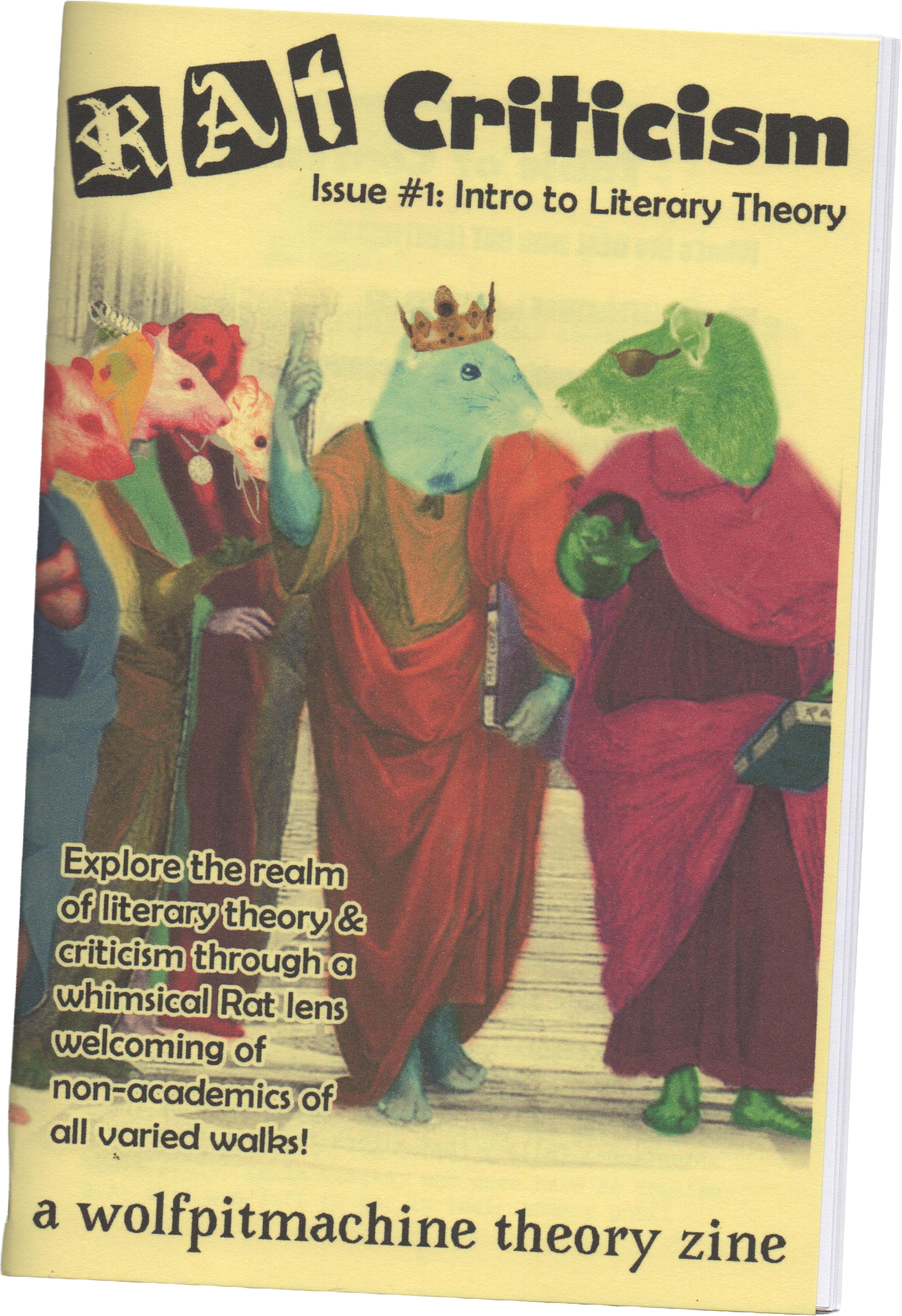
Rat Criticism - Issue #1: Intro to Literary Theory by L.V. Hartley / Wolf Pit Machine (2026)
A zine by yours truly as an informal introduction to literary theory under the spirited Rat philosophy for non-academics complete with whimsical edutainment comics! You can read digital copies entirely for free on the Rat Lore website page located here.
For more literary critcism readings, I'll reproduce the suggestions at the end of Rat Criticism #1 for easier reference:
Literary Theory: A Very Short Introduction by Jonathan Culler
Brief & accessible intro to theory that smoothly explores different functions of literature, criticism, & theory. Schools/movements are covered only briefly at the end, but they are mentioned as relevant in the core text exploring these broader concepts & facets of theory.
How to Interpret Literature: Critical Theory for Literary and Cultural Studies by Robert Dale Parker
NOTE: I read the 3rd edition, which is what I found cheaply
at my local used bookstore.
Highly readable introduction to literary theory
schools/methods with a specific focus on cultural
studies that I’m interested in. Good lists for
further reading at the end of each section.
Literary Theory: An Introduction by Terry Eagleton
Critical Theory Today: A User-Friendly Guide by Lois Tyson
The Penguin Dictionary of Critical Theory by David Macey
Beginning Theory: An Introduction to Literary and Cultural Theory by Peter Barry
UCLA Department of English Graduate Reading lists [link]
A list of the actual reading lists for Graduate courses you can access based on courses of interest to you. Reading lists & syllabi are excellent ways to find thematically or conceptually complementary readings.
Classpecting Supplemental
My current structure for class pairings for Mythoslain
| MASTER | |
| Lord (-) | Muse (+) |
| CREATION -- DESTRUCTION | |
| Witch (-) | Sylph (+) |
| Prince (-) | Bard (+) |
| POSSESSION -- UNDERSTANDING | |
| Thief (-) | Rogue (+) |
| Mage (-) | Seer (+) |
| SERVITUDE -- BEING | |
| Knight (-) | Page (+) |
| Maid (-) | Heir (+) |
| MASTER | |||
| Lord | Masters or Dominates [aspect] | Muse | Embodies or Channels [aspect] |
| CREATION | |||
| Witch | Manipulates or Creates [aspect] | Sylph | Heals with [aspect] or Heals [aspect] |
| DESTRUCTION | |||
| Prince | Destroys [aspect] or Causes Destruction via [aspect] | Bard | Allows [aspect] to be Destroyed or Invites Destruction via [aspect] |
| POSSESSION | |||
| Thief | Steals or Possesses [aspect] for self | Rogue | Steals or Possesses [aspect] for others |
| UNDERSTANDING | |||
| Mage | Understands or Guides [aspect] for self | Seer | Understands or Guides [aspect] for others |
| SERVITUDE | |||
| Knight | Wields or Exploits [aspect] | Page | Invites or Serves [aspect] |
| BEING | |||
| Maid | Protects or Restores [aspect] | Heir | Becomes [aspect] or is Consumed by [aspect] |
Full Class Inversions:
[CREATION] -- [DESTRUCTION]
[POSSESSION] -- [UNDERSTANDING]
[BEING] -- [SERVITUDE]
| Witch (-) | Bard (+) |
| Active Creation/Manipulation of [aspect] vs. Passive Destruction of or Permission of Destruction of [aspect] | |
| Prince (-) | Sylph (+) |
| Active Destruction of [aspect] or through [aspect] vs. Passive Creation of Healing of [aspect] or through [aspect] | |
| Thief (-) | Seer (+) |
| Active Theft and/or Possession of [aspect] for self vs. Passive Understanding and Guiding of/through [aspect] for others | |
| Mage (-) | Rogue (+) |
| Active Understanding and Guiding of/through [aspect] for self vs. Passive Theft and/or (Re)Possession of [aspect] for others | |
| Knight (-) | Heir (+) |
| Active Wielding/Exploitation of [aspect] in Service vs. Passive Becoming/Inheritance of the [aspect] and its Will | |
| Maid (-) | Page (+) |
| Active Becoming of [aspect] to Restore and Protect it as a part of self vs. Passive Servitude to be potentially Wielded by [aspect] | |
Class "Echoes:"
PRINCE & SYLPH
PRINCE - A Myth (Stasis)
SYLPH - A Fiction (Change)
SEER & THIEF
SEER - A Question
THIEF - An Answer
KNIGHT & HEIR
KNIGHT - A Lack
HEIR - An Abundance
NOTE: While this concept was designed for my work with Mythoslain as more of a loose creator side supplemental structure, it unintentionally fits EXCELLENTLY when applied to canon sessions, working best for the human sessions as a whole if combined & the influence of other transferred god tiered players are taken into account (i.e. having Kanaya fill in as Sylph with her Space aspect & Vriska fill in as Thief with her Light aspect). Even the other surviving trolls that share classes already present in this structure works.
My current structure for aspect pairings for Mythoslain
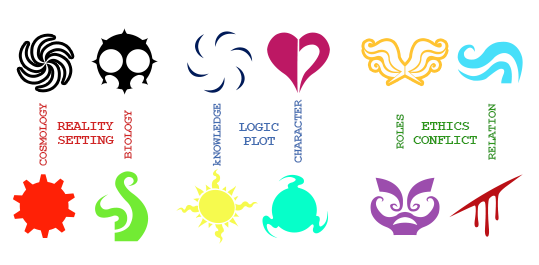
| REALITY / SETTING | ||
| COSMOLOGY | TIME | SPACE |
| Universal Scales, Cosmological Setting or Facts of Reality | ||
| BIOLOGY | LIFE | DOOM |
| Mortal Setting or Facts of Biology | ||
| LOGIC / PLOT | ||
| KNOWLEDGE | LIGHT | VOID |
| Structural Narratives of Plot and flow of Information/Knowledge, how Knowledge/Truth is organized & constructed | ||
| CHARACTER | MIND | HEART |
| Individual Character Arcs/Conceptions and Coherence of Experience, Notion of being Subject | ||
| ETHICS / CONFLICT | ||
| ROLES | RAGE | HOPE |
| Larger Scale Social Roles, Expectations, or Systems in Conflict | ||
| RELATION | BLOOD | BREATH |
| Interpersonal or Smaller Scale social interfacing in Conflict | ||